Showing posts with label visual art. Show all posts

Friday, January 22, 2010

New Camera, Part 2 (The Good Part)

1. I'm really out of practice with a good camera. It's not exactly like riding a bicycle (although I haven't ridden a bicycle in some time now, so maybe I would suck at that as well).

2. That being said, here are some of the promised photos I've taken so far. There are also a bunch of attempted shots of Stubby and Apple as I figure out just how high the shutter speed and ISO need to be to catch a running dog (I'm getting better at tracking already). They're not ready for prime time yet, however...


Tuesday, November 24, 2009

Home Depot is (still) not Venice


See Karin Gottshall's hilarious post here first.


Sunday, November 22, 2009

Hiroshima Mindstream

I just got facebook friended by Keith Linton. I encountered his multimedia (often acrylic, plastic, and canvas) work a few years ago and really liked it. There was one piece in particular, Mindstream, that stuck out in my mind. I had a postcard of it in front of me while later attending a lecture by Carol Mayor on Hiroshima Mon Amour, and the two media (four media?) started to mix and mingle in my head, the flashes of Hiroshima imagery on Powerpoint, the steady but dim image of Mindstream on the table in front of me. What resulted was a poem called "Hiroshima Mindstream," which never made it into the ekphrastic journals but was included in my second chapbook, Riff Raff, which consists solely of poems based on other works - paintings, poems, graffiti, movies, etc. The poem is below, and to see Keith's piece, visit his website and go to the works section (Mindstream is in the first column, third row).


Hiroshima Mindstream


One side of the canvas is lying


No line recovers so smoothly


So quickly


After this multicolored devastation


Babble of Hiroshimatic Japanese

An instant overflown

From 31,000 feet the impact site is small as a marble, or the bomb is small as a marble, or the marble flattens and expands to cover the ground in glass, a Borgesian map of its own destruction

Cobblestones become Venice

Pompeii streets fused with soles


This is not the roundness of a marble

No karma, no chakra

This is the door burst as the eyes of a woman looking at Little Boy

The floor fallen away as the jaw of a boy radiated, all teeth and roof of mouth and too soon this roof too will rot

Encapsulation shifts impossible as

skin bubbles and organs no longer hold

their place

Not sciomancy but anthropomancy


This is the memory betrayed


Memory recognizing itself in broken mirrors, recognizing the mirrors are not really broken


Perhaps this is not a lie


Perhaps I need it to be a lie

Tuesday, November 3, 2009

Stubby on Deck

Stubby has figured out how to jump up onto the table on our deck. He feels bigger up there, which is appropriate, since he thinks he's about twice his actual size. Or so I imagine based on his desire to wrestle with dogs that tower over him (note: wrestle, not actually fight). Apple figured out how to get on the table after watching Stubby, but I don't think she feels bigger. She actually thinks she's about half her size, based on how she always goes through the smaller of two spaces when weaving around legs and such. She's also afraid of the digital camera, so no photos of her up there.


Sunday, July 5, 2009

Revolutions, Roleplaying, Reverse-psychology

A belated Happy Independence Day to those of you celebrating it. Here's my day-after sketch, whilst thinking in the backyard about revolutions:


---

A bit I'm incorporating into diluvium from the smartest role-playing game ever devised, Nobilis. Most RPGs have what's called flavor text, wherein the quantitative component of the game is expressed in more qualitative terms. For something like Dungeons & Dragons, you'd get something like: "Rekzor advanced and smote the goblin on the head with his glowing mace (critical hit with mace +1). Nobilis has flavor text like this:

Once, a man was so well-liked that he set the fields ablaze and the peasants didn't mind.

Then he killed all the animals, gave his folk dust to eat, and they didn't mind.

Then he dirtied the water with blood from his wars, and they didn't mind.

Then they tortured him slowly to death on the Stone Wheel, and when his heirs asked the peasants why, they said, "We thought he liked that sort of thing."


Or, the lines I'm putting into diluvium:

8. Lady Urvasi and Lady Iya stood at the entrance to Hell. "I am strong," said Urvasi. "I can survive the worst torments of this place."

9. Lady Iya said, "You are strong; but is that strength an asset, here?"


How often do you get a game that lets you argue serious philosophical points not as a sidebar, but as one of the primary goals of the experience? It's like a living Sandman comic.

---

Lines from my spoken-word/performance piece "Zahir," which will end up on the same page as the hell bit from Nobilis:

Don't think of a tiger.
Don't picture the black and orange stripes undulating through tall grass.
Don't image the huge pads silent as the new moon, the low rumble of thunder in the lungs, the electricity in the sinews that precedes the rush and clutch, the chaotic tumble, the crunch of a dead deer's vertebrae.

Wednesday, April 8, 2009

The Inside of My Head


The first draft(s) of "Icarus the Young," the final text of which I posted yesterday.


Things are always moving in there. Sometimes loping, like a butterfly.


Sometimes I really have to grind away at an idea, like it's not even mine.

Sunday, February 15, 2009

AWP Day 3

Summary: Bad panels, good arts.

---

The first bad panel was not the panel's fault. It was extremely relaxing, in fact, with quiet and contemplative (but not taxing) poetry being read. Problem is, a 9:00am session on the third day of AWP is very much sleepy time for those of us staying up late. Combine these two elements, and our heads drooped onto each other's shoulders from time to time. Dear Willis Barnstone - sorry! Not your fault! Enjoyed the translations immensely!

---

Insert time for writing/snoozing here.

---

Second panel was a sham. I overstate the case, but if you're going to bill the event as bad poetry by good poets, don't allow two panelists in a row to get up and say, "Well, there really was nothing bad by this poet, so let me talk about an early work and a later work." The whole point of the panel was to be gossipy and shocky and other words that end with -y (I've been watching too much Buffy lately). We demand satisfaction.

---

The Art Institute was wonderful. We ended up going in circles a few times, which was a bit weird. The third time we'd seen the same statue, we finally consulted a map. That being said, it's a good thing to swing by the same piece multiple times, viewing it in a new temporal context each time. Modern Wing was closed due to construction, but we spent a couple of hours taking in everything else at a relaxed pace. February is free for general admission. Go.

---

I'll upload photos of the snow sculptures on Michigan Ave later.

---

Nobody on the panel about Chicago Poetry Slams showed, so an impromptu open mic was held. Fun times for all.

---

The Afterhours Slam didn't go how I was told it would, which was (for economic reasons - i.e. a chance to sell chapbooks) disappointing. On the other hand, I got to see both Megan Thoma and Logen read during the open mic. That was wonderful (both had people come up to them afterwards, yay!). Instead of featuring, I slammed off against a young man named Riler who won the poetry slam on Thursday night. He won, and he was quite good. I'd like to hear/see his work again. I used my semi-improv piece "Christmas List" as my last poem, incorporating things that a bunch of the other poets had said during the open mic. I think one of the poets was really touched - he looked a little teary when he came up afterwards to thank me for incorporating his words.

---

More sketches from boring panels:


Thursday, February 12, 2009

AWP Day 1 / Out of Sequence 2

The New England Review reading was great. The fiction writers in particular gave life to their selections, and the audience laughed. A lot. This is important.

---

Some panels, which will go unnamed, were not so good. This is a sketch of a bad panelist about to neuter the poetry s/he claims to love:


This is a sketch of a series of panelists so in love with themselves that their egoheadballoons begin floating up through the empty room.


---

Got to meet C. Dale Young and John Gallaher in person. Yay nonvirtuality!

---

Received an email from one of the high school students I performed for yesterday. He was too shy to raise his hand when I asked if there were any budding writers in the audience. He notes in his email that he's been trying to look at things differently, like looking at a tree stump and instead of thinking "a tree was there" thinking "a homeless man's stage." This kid gets it. I haven't responded yet, but I'm very excited.

---

Talked with my veryvery good friend Logen, who expressed disappointment on how fame works. Specifically, how the production of one good volume of poetry can get a poet "in" with a press, which then gives that poet seeming cart blanche for publication. Yes, we were oversimplifying a bit, but there's something about the sequence of publications that is disturbing. The work doesn't always improve. It often gets worse.

I added some comments about my performances at the high school yesterday and how changing the order of poems affects the reception of later ones. If I performed "Ma'am please put those jeans down" by Glenn Phillips (since I have it memorized, and it's rightly a crowd-pleaser) or "ADD TV," the kids would go crazy for anything else I did after that, even if I screwed up. Maybe the masses aren't quite so fickle as we think? To a/our fault?

---

Incredible Hulk Quandary Haiku

rippling suddenly
with verdant musculature
what would you do first?

---

I'm officially coining the term "nah-vant garde." So there.

Monday, January 26, 2009

To Understand, To Sum Up, To Leave Out

EDIT: Sorry if you got this multiple times through a feed reader. The first time out, the post was being marked November 2008. I don't know why.

---

This post begins with the job market. I'm on it this year. The requirements are slightly different for each available position in terms of what ought to be sent when, but each university to which I'm applying sooner or later (hopefully) will want a writing sample. That means 10-15 pages of poems.

For a moment, let me clarify something for those of you who aren't writers. No condescension, just making this clear: Narrowing down one's poems into a book-length collection is hard. You have more poems than can fit into a volume. You'd think that eliminating some would be easy - after all, there are poems you know aren't as good as others. But sometimes those lesser poems provide the perfect transition between two better poems. Now you're making a book that isn't just a collection of individual poems, but something that develops organically in the reader's mind. That's infinitely better than good poem -> good poem -> good poem. Chapbooks are shorter and, in a sense, easier. They're usually tightly-wound about a theme, or progress chronologically, or have some other guiding factor. They're also generally longer than ten pages.

To pick and choose ten pages of poems is to pretend that I'm not working towards some whole, a future collected works that isn't just a "greatest hits" volume but a cohesive (if slippery) worldview.

Add to this the variety of poetic styles I practice. I'm not saying I'm great in all or any of these, but I write postmodern and modern poetry. I produce visual and performance poetry. I have lyric and narrative and political and romantic verse. I'm supposed to pick 10 pages out of this to sum myself up for the committee?

I've made it into the second round of the selection process at a particular university (which will remain unnamed at this point in time), and the head of the selection committee let me send El Oceano y La Serpiente / The Ocean and The Serpent as my writing sample. This was a huge relief.

For the places yet to ask (or that I have yet to apply to) I'm debating whether or not to include, say, a DVD with "ADD TV" on it. Does a three-minute performance piece equal one page? Two pages? Three pages?

Sigh.

---

In related news, Ron Mohring over at Seven Kitchens has begun talking with me about cover images for The Icarus Sketches. I'll keep you updated when the top choice for artist gets back to us (if she gets back to us).

In the meantime, I'll take a page from Gary Sullivan and the many people who joined in last year.

Book covers I particularly like:


Alaskaphrenia by Christine Hume
Christine is a former professor of mine (and a damn good one). I also quite like her work and own three of her collections - Musca Domestica, Alaskaphrenia, and Lullaby. Of the three, I think I still read her debut most often, but the design on Alaskaphrenia is top notch.
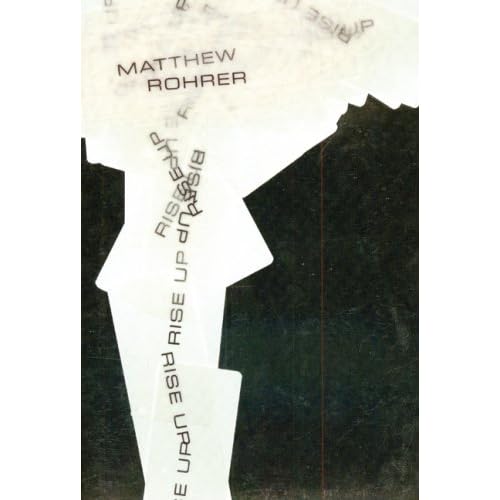

Rise Up by Matthew Rohrer
Reviewed (and also given props for its cover) at coldfront magazine.


Studying Poetry by Barry Spurr
An unconventional choice, but the covers of most how-to writing books, textbooks, suck. There's an honesty to the spiralling handwritten text that's sorely lacking in the neat, self-helpy appearance to most of these things.
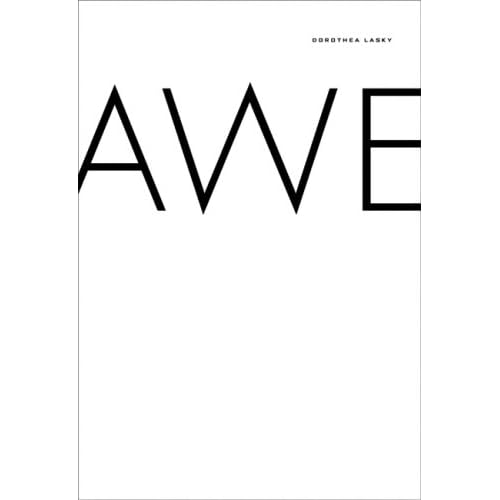

Awe by Dorothea Lasky
Seconding Clayton Banes on this one. I linked to Banes' blog above.

Bloodstains on a Battlefield by Roger Bonair-Agard
This is a standard slam poet's chapbook - run off at Kinko's or somesuch with almost no thought to design. But Bonair-Agard used crayons to draw unique sketches on every single cover. You can't beat that.

All the names thus far have been poets, not the folks who designed their books. To switch gears briefly:

Just about everything by Jeff Clark. He's good enough that some people have started to worry about him being too good. Sometimes they'll replace the word "good" with "slick" or "commercial" to cover the fact that they're worried about him being good. But really, just about everything from this guy is solid.

Anything Unicorn Press from the early 70s. For an example, check my previous post about Rexroth. Al Brilliant and his coworkers made some beautiful books. I recommend actually getting your hands on one, because their beauty is most often due to restraint and good proportions.

Ah what the heck - my first foray (and my second chapbook, under the auspices and tutelage of the aforementioned Al Brilliant). The image is by Antonio Pratsa:

Monday, November 24, 2008

Time / Lapse

I recently uploaded a number of old photos to Facebook. Knowing that some of you who read this blog do not have (nor want) (nor do I blame you for not wanting) access to Facebook, I'm putting up a few themed photos here. I'll let them speak for themselves unless somebody has a question, with one exception - none of these are digitally manipulated to create the main effect. That is to say, when I scanned in the photos, I used Photoshop or GIMP to restore the original color balance if at all possible. But the primary effects - the multiple instances of a single person, the smearing, all of those things that look like "special effects" - were done solely through the use of an open shutter and creative use of lighting.


Time / Lapse


Mind the Gap


State of Mind


What Big Eyes You Have


Born Slippy


Breaking Free


ifrit


Pentacostal

Saturday, November 22, 2008

2 male artists you need to check out now (and 2 to watch for in the future)

Already Made It

1. Jason Salavon

Salavon creates digital collages and alterations that are both aesthetically pleasing to mainstream viewers and utterly postmodern in the messages they send.

Here's a piece from Every Playboy Centerfold: The Decades. This image is the mean average of every centerfold image of the 80s. The production is most striking when you view the entire series and watch the skin and hair grow lighter, the abstracted body grow thinner.


Salavon's work is wide-ranging in its techniques and messages, so go check out the main site.

2. James Jean

Jean is perhaps best-known for being a comic book cover artist, particular for his work on Fables, for which he's won a number of Eisner Awards. His non-comic art is just as thought-provoking, drawing on various cultures for inspiration and producing images that are often soothing and creepy, childlike and suggestive of hidden knowledge.


Definitely look into purchasing the new hardcover collection of all his Fables covers.

Keep Your Eye On

1. Ivan Farr

I met Ivan at Cushing Library at A&M. He's doing interesting work in a variety of artistic areas: photography, architecture, sculpture. Here's a photograph of his that I own (a large, framed print, at any rate).


There's a great diversity of material on his website. Check it out.

2. Tim Weaver

Tim is turning my poem "ADD TV" into an installation piece. The project has gone through perhaps five iterations, each one a fascinating idea. The latest I heard from him was a sculpture onto which he would project the various characters in "ADD TV" all at once (we recorded footage wherein I performed the poem as normal, then went back and did the entire thing as each character - pretty hilarious at times). The audience can walk around the piece to get different perspectives, thus gaining some power to "change the channel." He was blogging his progress for a while, but things seem to have disappeared. I'll update this post if I can find out where he's hosting video of his multimedia work now...

Tuesday, November 11, 2008

deer pausing


I think this image may be closer to what I wanted to write in the poem just posted...

Friday, September 26, 2008

ENGL235, here's the powerpoint of art from Wednesday

Or not, since I can't upload a PowerPoint presentation [nor Impress presentation (that's the OpenOffice version, for those of you wondering) nor PDF file].

Sigh.

Here's the individual images - click each for a larger version. My apologies for such a long entry... One of these days I'll figure out Flickr or somesuch service... Extra credit (seriously... 1% on final grade) for those who can track down title/artist for each of the non-snapshot works (that means everything but the Xipe Totec image, the shot of Buckingham Fountain, the totally white image, the portrait of Neil Armstrong, the lolcat, the Kyle Field shot, and the elephants holding trunks)